
Why your temporary veneers feel way thicker than the real ones
I sat in my car after the dentist, ran my tongue over my new front teeth, and honestly, I wanted to cry. They felt massive. Like I had suddenly grown a set of horse teeth or shoved a couple of Chiclets under my lip. I kept checking the rearview mirror, convinced that everyone in traffic could see my mouth protruding like a cartoon character. If you are sitting there right now feeling like your speech is a mess and your lips are being pushed out, take a deep breath. I have been exactly where you are, and I promise your face isn’t stuck this way. The thick, bulky sensation of temporaries is one of the most common shocks in cosmetic dentistry, but it is a temporary hurdle on the way to a life-changing result. Today, we are going to dive into why this happens, why it is actually a safety feature for your smile, and how you can survive the next two weeks without losing your mind.
Your Mouth Is Not Broken and You Do Not Look Like a Horse
When I got my first set of temps, I made a huge mistake: I tried to ‘fix’ a slightly rough edge with a nail file. Please, for the love of your enamel, do not do that. I ended up making the tooth feel even weirder and had to go back for an emergency smoothing. That panic stems from the fact that our tongues are incredibly sensitive; even a hair-width change feels like a mountain. When you transform your tooth aesthetics, the transition phase is rarely glamorous. Temporaries are usually made of a single block of acrylic or composite resin, which lacks the refined, layered grace of the final product. Have you ever caught yourself staring in the mirror and wondering if you have made a massive financial mistake? You are definitely not alone.
Is this bulky look actually worth the hype?
It is the question everyone asks when they can’t quite close their lips comfortably. The answer is a resounding yes. According to the American Academy of Cosmetic Dentistry, temporary restorations are essential ‘blueprints’ that protect your sensitive underlying tooth structure while the lab crafts your permanent porcelain. Because the material used for temporaries is much weaker than the final porcelain, dentists have to make them thicker so they do not snap the first time you bite into a piece of toast. Think of them like a bulky winter coat; it keeps you safe and protected until the weather clears and you can switch back to a sleek, custom-fit jacket. While you wait, it is crucial to know how to stop your temporary veneer from falling off so you do not have to prolong the ‘bulky’ phase any longer than necessary.
Why Acrylic Needs Way More Room than Porcelain
The physics of it is pretty simple. Porcelain is incredibly strong even when it is thin as a contact lens. Acrylic, the stuff your temporaries are made of, is brittle. If your dentist made the temps as thin as the final veneers, they would crumble in hours. By adding that extra bulk, they ensure your teeth remain covered and comfortable—even if ‘comfortable’ feels like a bit of a stretch for your tongue right now. This extra material also allows your dentist to see how your bite responds to the new shape. If you follow expert tips for veneers, you will realize that this ‘trial smile’ is actually a safety net. It gives you a chance to test out the length and shape before the permanent ones are bonded for good. Trust the process, even when it feels like you are wearing a mouthguard.
How to Talk Without a Lisp When Your Teeth Feel Huge
The first thing you will notice is that your ‘S’ and ‘T’ sounds have gone rogue. My own experience was a comedy of errors; I tried to order a latte and ended up whistling at the barista. To fix this, you have to retrain your tongue to find the new back-wall of your teeth. Stand in front of a mirror for five minutes and read a book out loud. Over-enunciate every single syllable. You will feel ridiculous, but this forced exaggeration helps your brain map the new boundaries of your mouth. Unlike the transition period for Invisalign innovation where the trays are thin, these acrylic blocks are thick, so your tongue needs more room to maneuver. Slow down your speech by about twenty percent. Within forty-eight hours, your muscle memory will adapt, and the lisp will vanish. 
Eat Like a Pro to Keep Those Temps in Place
You are essentially wearing a temporary mask over your teeth held on by ‘weak’ glue—this is intentional so the dentist can pop them off later. To survive the next two weeks, you must adopt the ‘fork and knife’ rule. Even if it is a sandwich, cut it into tiny pieces. Never bite into anything directly with your front teeth. I once forgot this and bit into a firm piece of sourdough; I heard a sickening ‘pop’ and spent the rest of my lunch wondering how to stop your temporary veneer from falling off. Stick to soft foods like pasta, yogurt, and cooked vegetables. If you are debating veneers vs crowns, remember that both require this delicate temporary phase. Avoid anything sticky like caramel or gummy bears, which can act like a suction cup and pull the acrylic right off the prep.
Why You Must Stop Brushing Your Veneers Like Real Teeth
Aggressive scrubbing is the enemy of your temporary smile. You need to keep the area clean to prevent gum inflammation, but you cannot use a heavy hand. Use a soft-bristled manual toothbrush and gentle, circular motions. Most importantly, do not floss normally. If you pull the floss back up through the contact point, you risk catching the edge of the acrylic and snapping the whole bridge off. Instead, thread the floss through, clean the gum line, and then pull it out sideways. You have to stop brushing your veneers like they are real teeth because the material is porous and can stain or scratch easily. If a corner feels slightly rough, resist the urge to pick at it. If it becomes a distraction, knowing how to fix a sharp edge on your tooth until you can reach the clinic with a bit of orthodontic wax can save your sanity until your appointment.
The Mental Shift That Makes the Wait Tolerable
The ‘bulky’ feeling is sixty percent physical and forty percent psychological. Your brain is hyper-focused on the change. To get past the ‘horse teeth’ anxiety, remind yourself that the final porcelain will be approximately thirty to forty percent thinner and infinitely more translucent. These temps are just the rough draft. When I felt my most self-conscious, I looked back at expert tips for veneers to remind myself that this phase is the ‘trial smile.’ Use this time to evaluate the length. If they feel too long, tell your dentist now! This is your only chance to make adjustments before the master ceramist finishes the final set. You aren’t just waiting; you are beta-testing your new look.While you are sitting there assessing your ‘beta-test’ smile, there is a trap most people fall into: the obsession with absolute perfection. We have been conditioned to think that ‘white’ means ‘healthy,’ but in the world of high-end aesthetics, the ‘Toilet Bowl White’ is actually a rookie mistake. If you go too bright, the translucency—that natural light-play that makes teeth look real—is lost. You end up with what we call ‘socially visible’ teeth, which is a polite way of saying they look like plastic. When you are looking at teeth whitening secrets, the goal is to match the whites of your eyes, not the porcelain of your sink. Knowing how to tell if your veneers are too white for your complexion is the difference between a natural upgrade and a neon sign. 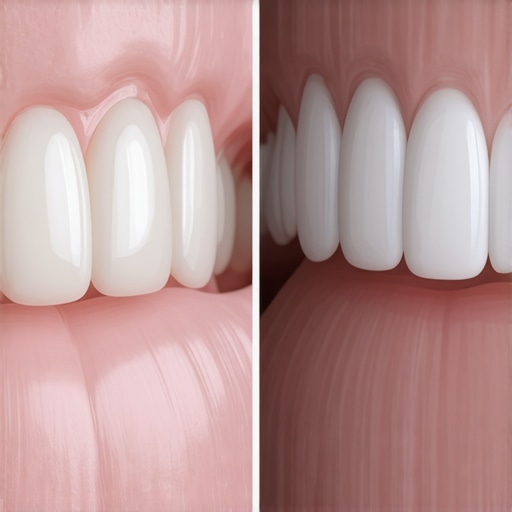
The Costly Mistake of Overlooking Gum Health
Then there is the ‘Oops’ factor regarding gum health. I have seen patients spend thousands on porcelain only for the results to be ruined by ‘angry’ gums. If your dentist does not address gingival health first, you risk ‘recession shadows’—that dark line at the top of your tooth. According to a study in the Journal of Esthetic and Restorative Dentistry, biological width—the specific distance between the edge of the restoration and the bone—is the most critical factor for long-term success. If that is ignored, why your gums look grey around your old porcelain crowns becomes a very real, and very expensive, problem. You also see this in family settings; what parents need to know in 2025 is that children’s gum health is the foundation for any future alignment.
Retraining Your Perspective on Aligner Sensation
Another common nuance involves the physical sensation of movement. Most beginners think ‘discreet’ means ‘unnoticeable sensation.’ But invisalign innovation and veneers require such precise maintenance that any slight shift feels like a disaster. Do not panic if your teeth feel like they are wobbling in their sockets. Understanding why your teeth feel loose during the second month of invisalign is part of the process—it is the periodontal ligament widening to allow for movement, not your teeth falling out.
How do I know if my veneers are technically failing before they actually fall off?
The first sign is not usually a loose tooth; it is a tiny line of discoloration at the margin. This is ‘micro-leakage,’ where bacteria seep under the bond. If you notice a dark thread-like line where the tooth meets the gum, your ‘permanent’ solution is starting to fail. This is often caused by the same aggressive habits that lead people to stop brushing your veneers like they are real teeth. Have you ever fallen into this trap—maybe choosing a shade too white or ignoring a tiny gum issue until it was too late? Let me know in the comments.The truth is, once the ‘honeymoon phase’ of your new smile wears off, reality sets in. You realize that your investment is only as good as your daily maintenance routine. I used to think a standard toothbrush was enough, but after seeing how quickly plaque can build up around the margins of a veneer, I switched to a high-frequency sonic toothbrush. According to the Journal of Clinical Periodontology, power toothbrushes—specifically those with oscillating-rotating technology—show a significantly greater reduction in plaque and gingivitis compared to manual brushing. If you aren’t using one, you are basically leaving your dental health to chance. Another game-changer for me was the water flosser. While I mentioned that you shouldn’t pull floss up through your temps, even with permanent veneers, traditional string can be tricky. A water flosser allows you to clean those deep pockets without the risk of snagging a bond. This is especially vital for anyone undergoing Invisalign innovation because the attachments can become magnets for bacteria. If you do not know how to remove aligner attachments without damaging your enamel at the end of your treatment, you will see why the clean-up process is just as important as the alignment.
Stop Relying on Luck to Keep Your Teeth White
The biggest threat to your new look isn’t usually a physical break; it is the slow, creeping stain from your morning habit. I refuse to give up my coffee, but I had to learn how to prevent coffee stains on your new veneers without using abrasive charcoal pastes that scratch the surface. The secret is immediate rinsing and using a pH-neutralizing mouthwash. When you look into top teeth whitening strategies today, you will find that consistency beats intensity every time. #IMAGE_PLACE_HOLDER_D#
How do I maintain my results for decades instead of years?
The unsung hero of longevity is the night guard. Most of us grind our teeth when we are stressed, and porcelain—while strong—can fracture under the immense pressure of a midnight clench. You must learn how to properly clean a night guard to prevent bacterial buildup, or you are just introducing a petri dish to your mouth every night. Looking forward, I predict that ‘Bio-dentistry’ will become the standard by 2030, where we use 3D-printed biological scaffolds to regrow enamel rather than just covering it. We are already seeing this shift as dentists are swapping traditional x-rays for 3d scans to get a micron-perfect fit. If you take one thing away from my journey, let it be this: Buy a high-quality water flosser today. It is the single most effective way to protect the gum line where your veneers or crowns meet your natural tooth. Do not wait for a ‘grey line’ to appear before you start taking maintenance seriously.
The Reality Check Your Dentist Might Have Skipped
After living through the ‘bulky’ phase, I realized three things that no brochure really explains. First, your brain is actually a bit of a liar; it amplifies the sensation of new material because it perceives it as a foreign object. Within 72 hours, your neural pathways settle down, and that ‘giant’ feeling subsides even if the physical size hasn’t changed. Second, the lisp you are fighting is a temporary calibration. If you can master your ‘S’ and ‘T’ sounds on these thick acrylics, the sleek porcelain will feel like a dream. Finally, remember that this phase is an insurance policy. If you can handle the mechanics of eating and talking now, your final result will be bulletproof.
Tools That Saved My Sanity and My Bond
You cannot treat a high-end cosmetic investment like a set of standard molars. To keep everything pristine, I swear by a few specific items. A high-quality water flosser is non-negotiable for cleaning the margins where the veneer meets the gum without risking a ‘pop’ from traditional string. I also recommend a pH-neutralizing mouthwash to combat acidity, which is one of the best ways to prevent coffee stains on your new veneers. If you are a coffee or tea lover, learning how to keep your teeth white without giving up black tea will save you hundreds in touch-up treatments. Lastly, never skip the night guard; just make sure you know how to properly clean a night guard so you aren’t trapping bacteria against your new work. Following top teeth whitening strategies today will also ensure your adjacent teeth stay as bright as your new restorations.
Believe in the Power of the Final Reveal
The transition from the ‘bulky’ temporary phase to the final porcelain is nothing short of miraculous. You are currently in the middle of the ‘ugly duckling’ stage, but it is the necessary path to transform your tooth aesthetics into something you are proud to show off. Don’t let the temporary thickness discourage you from your goal. The precision, translucency, and comfort of the final set will make these two weeks feel like a distant memory. You have done the hard part by starting the journey—now just let the process work its magic. Have you ever felt like your ‘trial smile’ was a bit too large for your face, or are you currently in the middle of the lisp-struggle? Let me know in the comments below!